


Reposting the same short-form video everywhere sounds efficient until the results start looking strange. A TikTok can get strong watch time, comments, and saves, then the exact same file can land flat on Instagram Reels. Or the reverse can happen: a clean Reel can get shared around Instagram, then feel too slow for TikTok.
That does not mean creators need two completely separate content calendars. It means Instagram Reels vs TikTok is less about choosing one platform and more about understanding how each platform rewards behavior. The same idea can work on both, but the hook, pacing, caption, audio, and proof usually need a platform-specific pass.
The short answer: same idea, different edit
For most creators, the best answer is not “post the exact same thing” or “make everything from scratch twice.” The practical answer is: create one strong idea, then make a TikTok edit and a Reels edit from it.
TikTok is usually better for fast discovery, trend participation, raw testing, and reaching people who have never heard of the creator. Instagram Reels can also drive discovery, but it sits inside a broader social graph where profile trust, shares, saves, DMs, and previous interaction with the account matter a lot.
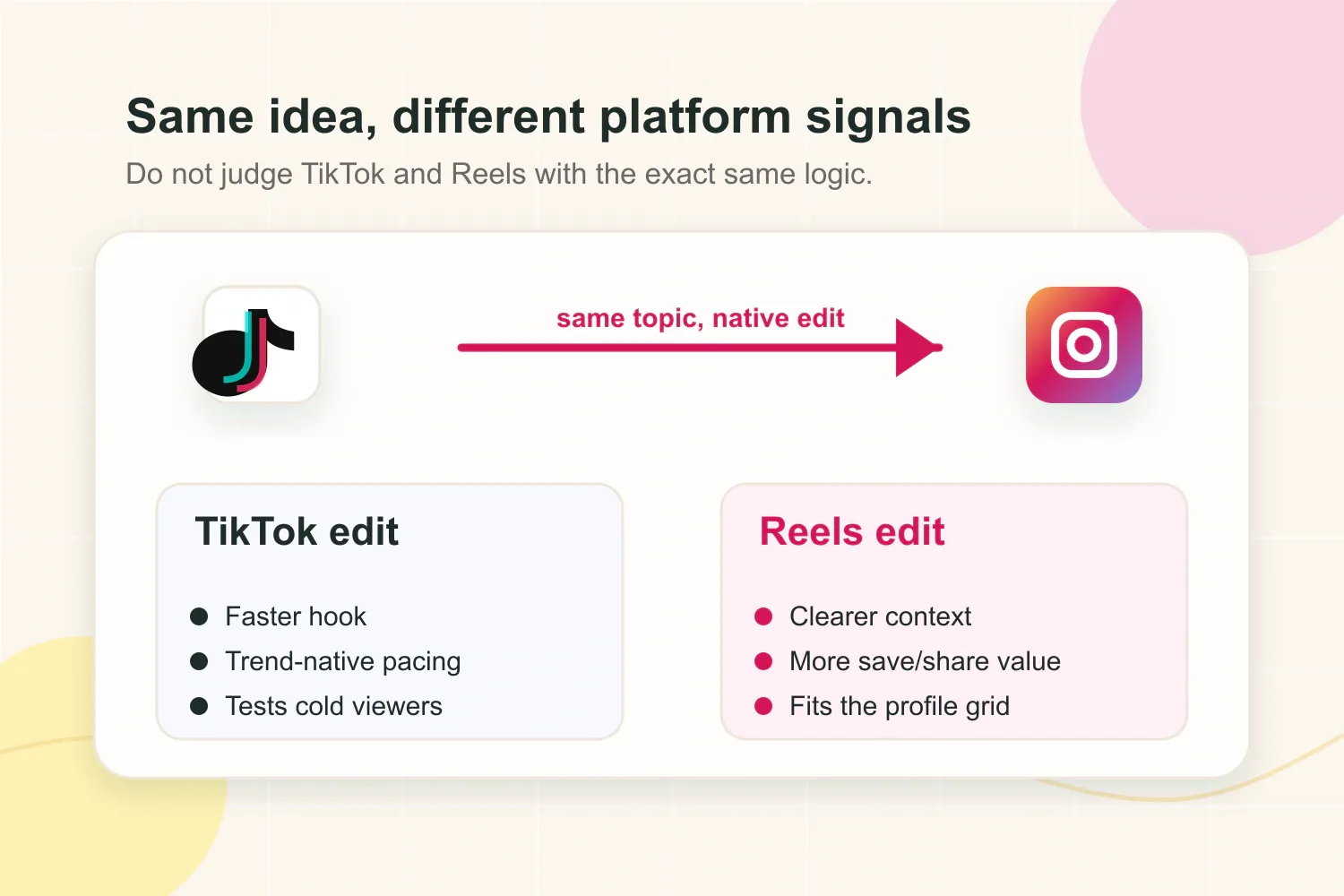
That difference changes how a video should feel. TikTok can reward a fast, native, slightly messy idea if it gets people to watch. Instagram often rewards a clearer, more polished version that fits the creator’s profile and is easy to share.
Why TikTok and Reels do not behave the same
TikTok was built around the For You feed. According to TikTok’s own support documentation on how TikTok recommends content, recommendations are influenced by user interactions, content information, and user information. In plain creator terms, TikTok is constantly testing whether a video matches a viewer’s behavior.
That is why a small creator can sometimes reach a large audience quickly on TikTok. The platform does not need the viewer to follow the creator first. It can test the video with people who seem likely to care about the topic, sound, format, or behavior pattern.
Instagram Reels works differently because Reels lives inside Instagram, not as a separate app. Instagram has discovery surfaces, but it also has followers, profile visits, DMs, Stories, carousels, saved posts, and existing relationships. Instagram explains in its own guide to how ranking works that different parts of the app use different signals.
For creators, this matters because Instagram is not only judging one Reel in isolation. The account context matters too: what people usually do with the creator’s content, whether they share it, whether they watch again, whether they save it, and whether the account already has a clear content lane.
What each platform tends to reward
A simple way to think about the difference is this: TikTok asks, “Will this video hold attention right now?” Instagram asks that too, but also asks, “Does this fit how people already interact with this account?”
| Area | TikTok usually rewards | Instagram Reels usually rewards |
|---|---|---|
| Hook | Fast pattern interrupt, trend fluency, immediate payoff | Clear promise, visual polish, shareable framing |
| Discovery | Strong video-level performance with new viewers | Mix of new viewers and existing account signals |
| Audio | Trend sounds, native references, fast meme cycles | Original audio, trending audio, and cleaner brand-safe edits |
| Caption | Short context, search terms, trend language | Context, keywords, save/share reasons, sometimes longer captions |
| Success signal | Retention, completion, rewatches, comments, saves | Watch time, replays, shares, saves, profile actions, relationship signals |
This is why a TikTok that starts with an inside joke or trending sound may not translate to Instagram if the audience does not recognize the reference. It is also why a polished educational Reel may feel too slow on TikTok if it waits too long to deliver the point.
When posting the same video is fine
Posting the same core video on both platforms can still make sense. It is especially useful when the creator is early, time is limited, or the content is evergreen.
The same video is usually fine when:
- The content teaches something simple and useful.
- The hook makes sense without platform-specific context.
- The video has no visible watermark.
- The caption can be rewritten for each platform.
- The creator is still testing which platform deserves more time.
- The content is not built around a trend that only makes sense on one app.
A skincare creator explaining how to layer products can probably use the same core clip on both platforms. A fitness creator demonstrating a simple form correction can do the same. A creator reacting to a very specific TikTok trend may need a different Instagram version because the joke may not land there.
The mistake is not repurposing. The mistake is lazy republishing: same watermark, same caption, same first frame, same audio assumptions, same hashtags, and no thought about how people use each platform.
When the video should be different
A platform-specific edit becomes more important when the video depends on trend culture, platform jokes, niche behavior, or a specific type of engagement.
Different edits usually make sense when:
- The TikTok version uses a sound, stitch, duet, meme, or comment trend that does not travel well.
- The Instagram audience expects cleaner visuals or more context.
- The creator wants saves, shares, profile visits, or brand credibility from Reels.
- The TikTok version is extremely fast and needs more context for Instagram.
- The Instagram version is polished but too slow for TikTok.
- A brand collaboration needs different deliverables for each platform.
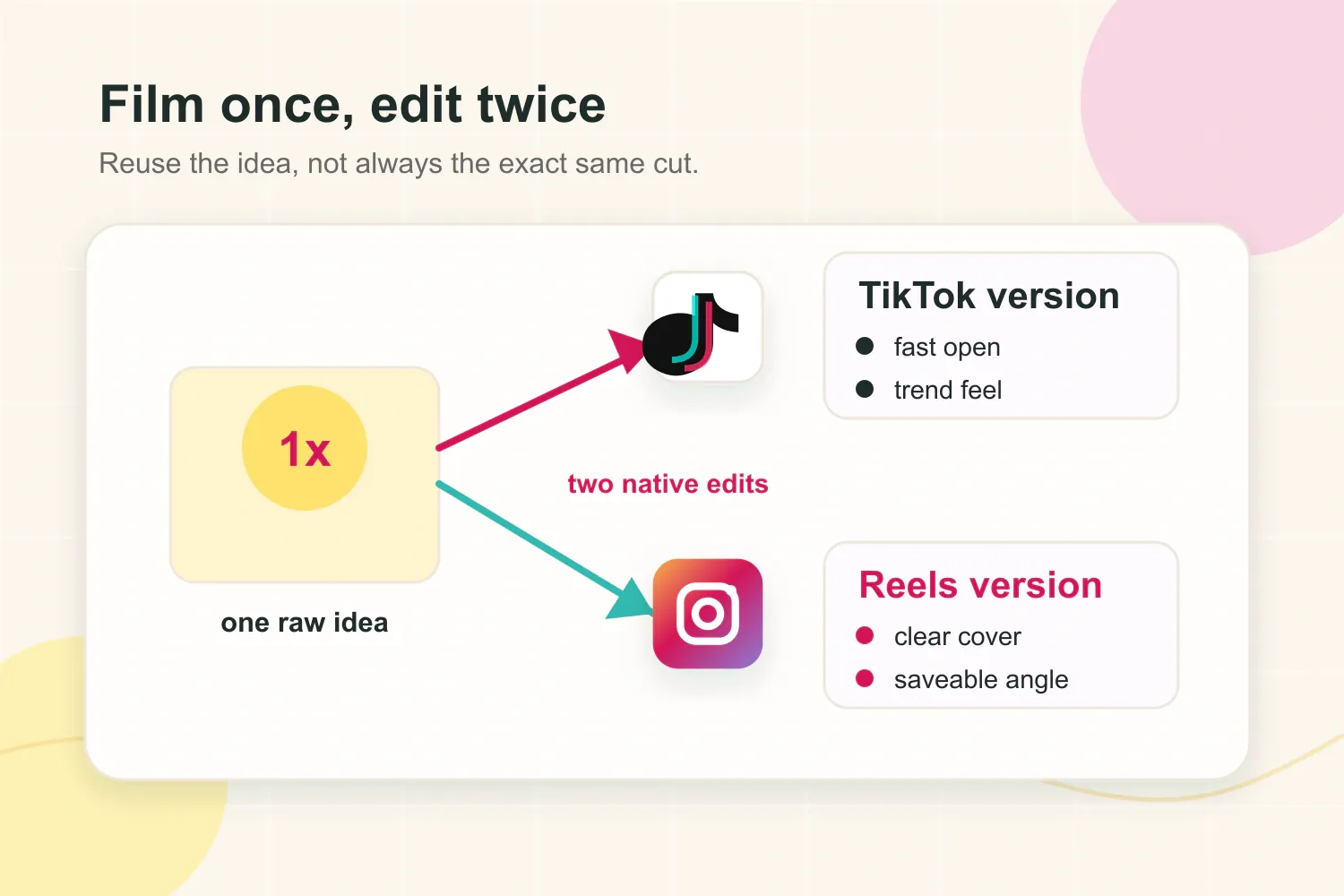
A creator can still film once. The difference is in the edit. The TikTok version might open with a faster hook, use a trend-native structure, and keep the caption short. The Reels version might use a cleaner cover frame, stronger on-screen context, a more shareable caption, and a callout that makes the value obvious without relying on TikTok culture.
How to adapt one idea for both platforms
The best workflow is to separate the idea from the edit. The idea is the core message. The edit is how that message fits the platform.
For example, the core idea might be: “Three mistakes creators make when sending a brand rate.” That idea can become:
- A fast TikTok with a strong verbal hook and quick cuts.
- A Reel with a cleaner first frame, slightly more context, and a caption that explains when each mistake happens.
- A carousel later if the topic deserves a saved reference.
This keeps production efficient while avoiding the “same video everywhere” problem.
A practical repurposing workflow looks like this:
- Film the main idea with a little extra footage.
- Create the TikTok edit first if the idea is trend-led or fast-paced.
- Create the Reels edit first if the idea is educational, polished, or brand-facing.
- Rewrite the first three seconds for the second platform.
- Rewrite the caption around that platform’s audience behavior.
- Compare results after a fair testing window, not after one post.
What to change before reposting a TikTok to Reels
If a creator wants to reuse a TikTok on Instagram Reels, the minimum standard is simple: make it feel native to Instagram.
That usually means removing the watermark, checking the crop, rewriting the caption, and making sure the first frame does not look like a recycled TikTok export. If the hook relies on a TikTok-only audio or trend, the Reel may need a new opening line.
A stronger Reels version often includes:
- A clear first frame that works even with the sound off.
- A caption that gives context and makes the post easier to save or share.
- Cleaner pacing if the TikTok version moves too quickly.
- A stronger visual connection to the creator’s profile style.
- A reason for followers to send it to someone else.
The point is not to make Reels boring or overproduced. The point is to remove friction. If someone sees the Reel in Explore or from a friend’s share, they should understand the value without needing to know the TikTok trend behind it.
What to change before reposting a Reel to TikTok
Moving a Reel to TikTok has the opposite problem. A polished Instagram edit may need more speed, more tension, or a more native hook.
TikTok viewers often decide quickly whether a video feels made for the platform. A clean Reel can still work, but if it starts too slowly, looks too branded, or takes too long to reach the point, it may lose attention before the useful part arrives.
A stronger TikTok version often includes:
- A faster hook in the first second.
- A more direct spoken opening or on-screen setup.
- A shorter path to the payoff.
- Audio that fits TikTok behavior, not just Instagram aesthetics.
- A caption that includes natural search phrases people might use on TikTok.
For creators who make educational content, this does not mean chasing every trend. It means packaging the idea in a way that matches how TikTok users discover and judge videos.
Use Reels and TikTok for different goals
The biggest mistake is measuring both platforms with the same goal. A TikTok may be better at reaching strangers. A Reel may be better at turning existing interest into trust, saves, profile visits, DMs, or brand-safe proof.
For a creator trying to grow, TikTok can be the testing ground. It can show which hooks, topics, and formats get attention from cold viewers. Instagram can then help deepen the relationship through Reels, Stories, carousels, DMs, highlights, and profile proof.
For a creator trying to win brand deals, the question becomes more specific. Which platform helps the creator show value? A TikTok with huge reach can be useful. A Reel with strong saves, shares, profile visits, and comments from the right niche can also be valuable. Brands rarely care about views alone if the audience fit is weak.
For deeper platform-format decisions, this guide on Instagram Reels vs carousels vs images is useful because it separates reach from saveability and profile value.
How to test the difference without guessing
A simple test is better than arguing about which platform is “better.” For four weeks, use the same content ideas but change the edit by platform.
The test can look like this:
- Week 1: Post the same core idea on both platforms with small changes to caption and cover frame.
- Week 2: Change the hook and pacing for each platform.
- Week 3: Test a more native TikTok version and a more saveable Reels version.
- Week 4: Repeat the strongest pattern and compare the results.
A useful experiment does not require a huge audience. It only requires consistent topics and clean tracking. If every post is about a different niche, the results will be hard to read.
A creator comparing performance should track:
- Reach from non-followers.
- Average watch time or retention.
- Completion rate.
- Replays.
- Shares and saves.
- Profile visits.
- Follower conversion.
- Comments that show real interest.
- Brand inquiries or DM replies.
The official Instagram Creators account has shared Reels ranking advice around signals like watch time, likes, and sends. That is the kind of reminder creators should keep in mind when judging a Reel: a view is useful, but the actions after the view usually say more.
How creators should read the results
A TikTok getting more views does not automatically mean it is the better business platform. A Reel getting fewer views does not automatically mean it failed.
The better question is what the video did for the creator. Did it attract the right audience? Did it bring followers who match the niche? Did it create saves, shares, replies, or brand interest? Did it give the creator a stronger content example for a media kit?
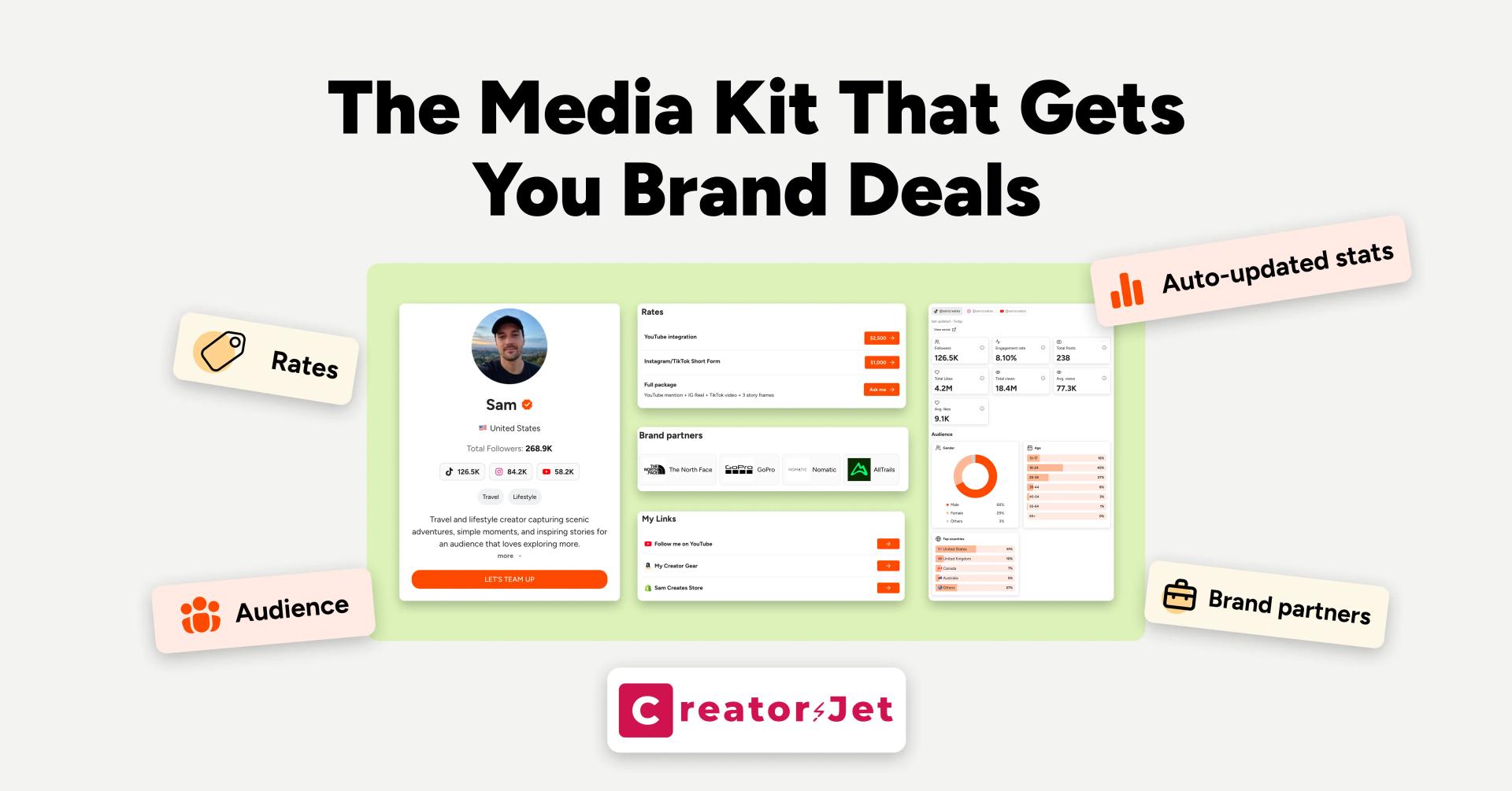
If a creator wants sponsorships, performance proof matters. That could mean showing average Reel views, TikTok reach, engagement rate, audience location, niche fit, or previous collaboration results. A live creator media kit can make those proof points easier to present when brands ask for stats.
A practical decision rule
Creators can use this simple rule:
If the idea is evergreen, educational, or based on a clear problem, reuse the core concept across both platforms. If the idea depends on platform culture, a specific trend, or a very particular audio, adapt it more heavily.
If the goal is pure discovery, start with TikTok-style pacing. If the goal is trust, profile value, or brand-safe proof, build a stronger Reels version. If both goals matter, film once and edit twice.
This is also where creators should avoid overcomplicating the process. A small creator does not need a full production system for every post. The first upgrade is usually enough: change the hook, remove the watermark, rewrite the caption, adjust the pacing, and track what happens.
Final thoughts
Instagram Reels and TikTok are close enough that the same idea can travel across both platforms. They are different enough that the exact same video will not always perform the same way.
The best creator workflow is not duplicate everything or reinvent everything. It is to build strong ideas, then adapt the packaging. TikTok can test attention quickly. Reels can turn that attention into trust, saves, shares, and profile depth. Creators who understand that difference can grow more efficiently without doubling their workload.